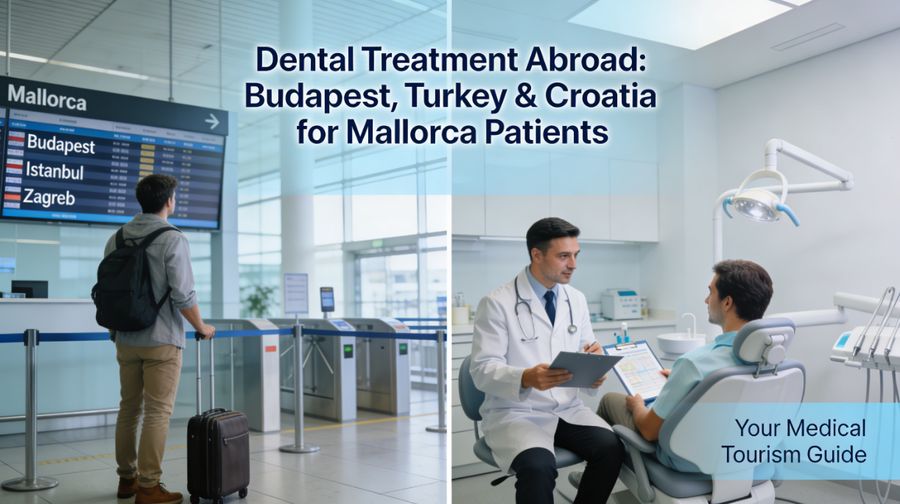
 Mallorca residents who are considering dental treatment abroad usually have clear priorities: reliable clinical quality, transparent prices, and easy travel connections. Budapest in Hungary, alongside Turkey and Croatia, has become one of the main reference destinations for Spanish and other Western European patients seeking implants, crowns, and full-mouth rehabilitations at more accessible costs.
Why Mallorca patients look abroad for dental work
In Spain, and especially on islands like Mallorca, private dental care can become expensive when a patient needs multiple implants, bridges, or a complete restoration of both arches. Waiting lists in the public system, combined with limited coverage for many dental procedures, push patients to look for alternatives that offer both quality and savings.
Dental tourism allows Mallorcan patients to:
-
Reduce overall treatment costs for complex work by a significant percentage versus local private prices.
-
Access clinics that are highly specialized in implantology and aesthetic dentistry, used to handling complex full-mouth cases.
-
Concentrate treatment into a small number of planned trips, limiting days away from home and work.
Budapest, Turkey, and Croatia have built solid reputations in this field, but each destination has specific characteristics that are important to understand before choosing.
Budapest (Hungary): strong focus for Mallorcan patients
Budapest is today one of the best-known European capitals for dental tourism and attracts thousands of patients every year from Spain, the UK, Ireland, Germany, and other Western countries. The Hungarian capital has combined several strengths: highly trained dentists, modern clinics, and prices that are often 50–70% lower than in Western Europe for major procedures.
Clinical quality and treatments
Hungarian clinics that work with international patients typically offer:
-
Advanced implantology (single implants, All-on-4, All-on-6, full-arch rehabilitations).
-
Porcelain and zirconia crowns and bridges, with in-house digital labs for precise, aesthetic results.
-
Aesthetic dentistry (veneers, smile design) combining function and appearance, which is especially appreciated by Spanish patients.
Many centers are equipped with 3D CT scanners, digital impression systems, and CAD/CAM milling machines, allowing for precise planning and, in some cases, faster prosthetic delivery. This technological setup makes Budapest particularly attractive for Mallorcan patients who want predictable, long-lasting results.
Experience with Spanish-speaking patients
Some Budapest clinics have specific experience with Spanish and Italian patients and offer full language support during all phases of treatment. This includes:
-
Initial consultation and explanation of the treatment plan in Spanish, via email, video call, or phone.
-
Translation of consent forms and post-operative instructions into the patient’s language.
-
Coordinators who help organize flights, accommodation, and local transfers, simplifying the entire journey.
This strong organization gives Mallorcan patients an experience that feels close to being treated at home, but with significantly lower costs and more specialized implant services.
Costs and savings
Compared with private prices in Western Europe, patients can often save up to about 50–70% on complex treatments in Budapest, especially on multi-implant cases and full-mouth reconstructions. While exact amounts vary by case and clinic, the combination of lower operating costs and high patient volume allows Hungarian centers to maintain quality without inflating prices.
For Mallorcan patients, the total budget will include flights from Spain, accommodation for several nights, and any local expenses, but even after adding these, many still find the overall cost clearly lower than equivalent work at home.
Travel from Mallorca
Reaching Budapest from Mallorca usually involves a flight via a mainland hub such as Barcelona, Madrid, or another European city with direct connections to Budapest. Because the city is well connected with major European airports, patients can often plan:
-
An outbound flight the day before the first appointment.
-
A series of treatment sessions concentrated into a few days.
-
A return flight with enough rest time after major procedures.
Some clinics include airport transfers and accommodation advice in their service packages, making the logistics easier for patients arriving from Spain.
Turkey: aggressive prices and full packages
Turkey has grown explosively as a dental tourism hub, especially for implants and full-mouth rehabilitation, thanks to very competitive prices and all-inclusive packages. Many clinics in cities such as Istanbul, Antalya, and Izmir offer:
-
Bundled treatment + hotel + transfer packages designed for international patients.
-
Very low prices for single implants and full-arch solutions compared with Western Europe.
-
Multilingual staff and marketing strongly targeted at European visitors.
Prices and packages
Current data show that in Turkey:
-
Single implants can cost roughly between a few hundred and under a thousand US dollars.
-
All-on-4 implant solutions per arch are often quoted in ranges that remain far below Western European prices.
-
Full-mouth implant packages, sometimes including hotel and transfers, are frequently 50–70% cheaper than similar work in countries such as the UK or other high-cost markets.
For Mallorcan patients, this can be financially tempting, especially if there is a need for extensive, bilateral implant work or a full smile makeover.
Points to consider
Turkey is not part of the European Union, so European patients do not benefit from EU-level regulatory harmonization or cross-border healthcare mechanisms, and legal frameworks differ from those in EU destinations. Quality among clinics can be very high in leading centers but more variable overall, so it is crucial to carefully verify credentials, experience, and guarantees.
Moreover, travel from Mallorca to Turkey generally involves longer flights and at least one stop, which can make the trip more demanding in terms of time and organization compared to a shorter route within the EU. For many patients this is acceptable for a single, extensive treatment episode, but it is important to plan carefully in case future follow-up is needed.
Croatia: EU standards and tourist appeal
Croatia has become a respected player in dental tourism, particularly for patients from nearby European countries who want to combine treatment with a seaside or city holiday. Clinics in Zagreb, Split, and other cities offer:
-
Quality implantology and prosthetic work at lower prices than in Western Europe.
-
Multilingual dentists and staff, accustomed to foreign visitors.
-
EU healthcare standards, with traceable materials and recognized accreditations.
Prices and quality
Available figures indicate that in Croatia:
-
A titanium implant including abutment is generally in the mid-range compared with Western Europe.
-
All-on-4 solutions per arch are priced at levels that remain advantageous for many patients compared to their home countries.
Croatian clinics invest in modern technology, in-house dental labs, and continuous professional training, offering a balance between cost and clinical quality. This makes Croatia an interesting option for Mallorcan patients who prefer to stay within the EU framework while still achieving meaningful savings.
Destination and travel
Croatia also positions itself as a tourism-focused destination, emphasizing the combination of dental treatment and a pleasant stay along the Adriatic coast or in historic cities. For patients from Spain, travel typically involves a connection through a major European hub, giving options to arrive either via Zagreb or coastal airports, depending on the chosen clinic.
Budapest vs Turkey vs Croatia for Mallorca patients
The table below summarizes the main differences for a Mallorcan patient evaluating Budapest, Turkey, and Croatia for dental treatment abroad.
| Aspect | Budapest (Hungary) | Turkey | Croatia |
|---|---|---|---|
| Regulatory context | EU member, European standards and oversight. | Non-EU; separate legal and healthcare framework. | EU member, strict standards and accreditations. |
| Main strengths | High specialization in implants, strong dental tourism infrastructure, multilingual staff. | Very low prices, all-inclusive packages, high volume of international patients. | Good quality/price balance, EU standards, tourist-friendly destinations. |
| Typical savings vs Western Europe | Often 50–70% on complex treatments. | Frequently 50–70% lower package prices than in many Western countries. | Savings up to around 60–70% reported in some cases versus high-cost markets. |
| Experience with foreign patients | Long tradition; extensive testimonials and reviews; strong coordination services. | Rapid growth; many clinics fully focused on international tourists. | Solid but more limited; many clinics target European visitors with multilingual teams. |
| Travel from Spain | Good connections via major European hubs; manageable flight times. | Longer routes and at least one stop; more demanding travel time. | Connections via European hubs; similar complexity to Budapest in many cases. |
| Ideal for | Patients seeking EU-level setting, structured follow-up, and strong implant expertise. | Patients prioritizing maximum cost savings and accepting non-EU framework. | Patients wanting a balance between EU setting, seaside/holiday setting, and lower costs. |
From this perspective, Budapest stands out as a particularly balanced option for Mallorcan patients who want strong clinical quality, clear guarantees, and still a very competitive price level within the EU. Turkey can be very attractive on price and package simplicity, while Croatia offers a quieter, holiday-like environment with solid EU standards.
What Mallorca patients should evaluate before choosing
Whichever destination is selected, the success of dental tourism for a patient from Mallorca depends largely on careful preparation and the choice of the right clinic.
Key aspects to check include:
-
Professional background and specialization of the dentists, especially for implant and prosthetic work.
-
Range of treatments offered and examples of similar cases treated in the past (with photos or testimonials).
-
Clarity of the written treatment plan, including timelines, costs, materials, and any alternative options.
-
Guarantees and follow-up policy, especially if complications or adjustments are needed after returning to Spain.
Well-structured clinics typically provide free initial estimates based on panoramic X-rays or 3D scans sent by email and are transparent in explaining the phases of surgery, healing, and prosthetic restoration. This transparency is essential for avoiding misunderstandings and planning the number and length of trips from Mallorca.
Travel planning from Mallorca to Budapest, Turkey, or Croatia
Travel planning is a crucial part of the dental tourism experience for island residents. Mallorcan patients often:
-
Fly from Palma de Mallorca to a hub such as Barcelona or Madrid, then connect to Budapest, Istanbul, or a Croatian city depending on the chosen clinic.
-
Combine the first consultation and surgical phase into a single trip of several days, followed by a second visit months later for final prosthetics.
-
Add one or two extra days at the end of the trip to rest and allow for post-operative checks before flying back.
Some clinics in Budapest and other destinations offer free airport transfers or help to book nearby hotels, simplifying logistics and reducing stress. With proper coordination, even patients who have never traveled for healthcare can feel comfortable navigating the process.
For whom Budapest is the best fit
Considering quality, travel, and overall experience, Budapest is especially suitable for Mallorcan patients who:
-
Need medium or large implant and prosthetic restorations and want a high level of technical expertise.
-
Prefer to stay within the European Union for legal and regulatory reasons, while still achieving substantial savings.
-
Value clear communication, transparent treatment plans, and structured follow-up for the long term.
Turkey and Croatia remain valid alternatives and can be considered depending on personal priorities: Turkey for maximum savings and all-inclusive packages, Croatia for combination of treatment and Adriatic holiday in an EU context. For many patients from Mallorca, however, Budapest offers a reassuring mix of price, quality, and organization that makes the journey for dental care abroad a rational and sustainable decision.